A minute of setup makes every number more accurate. If one looks wrong, check your setup first.
Set up in a minute
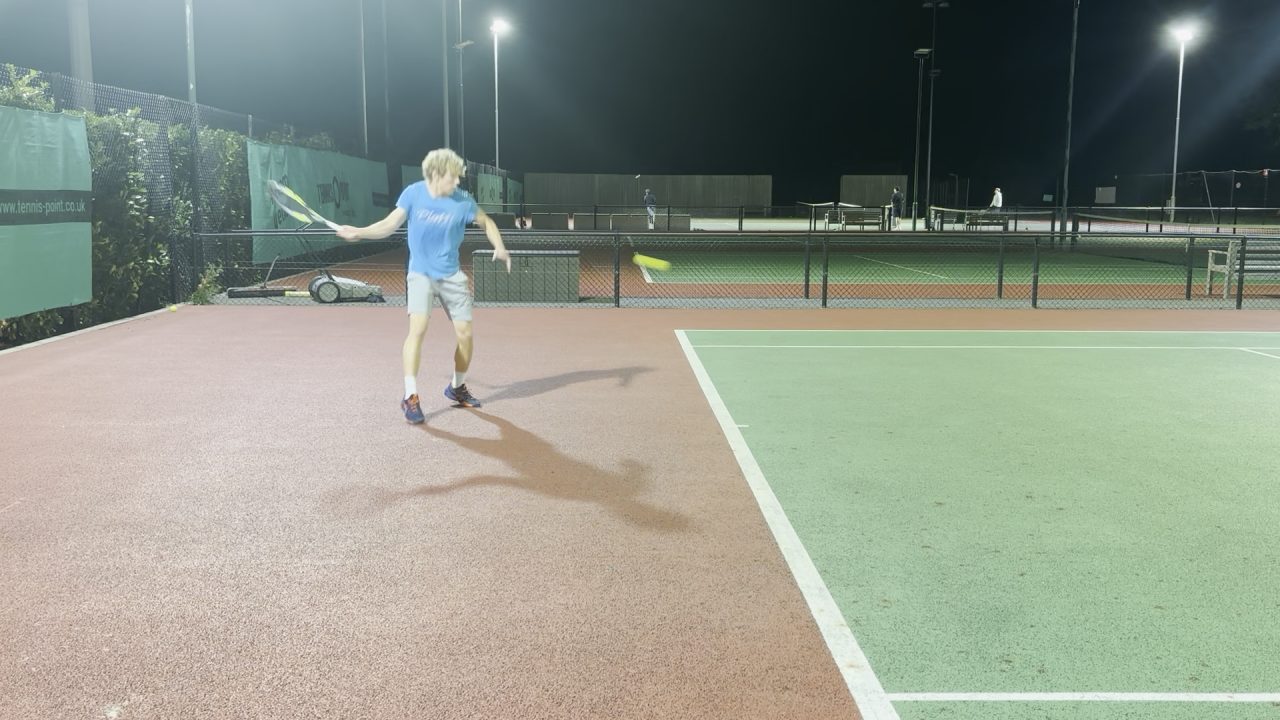
Tripod at the side of the court, level with where you hit: 5–6 m away (about 4 m for a junior),
waist height, phone sideways.
From above
Side-on, looking across your shot. On a full court the doubles side line is
5.5 m from the centre mark: just right.
From the side
Straight across, not looking down. Filming from the stands or a fence
top squashes your stance and knee bend.
Check the screen
Stand where you'll hit and look before you press record. You should fill
about half the screen height, with room either side for the racket.
Tripod on the side line, level with where you hit.
Phone at waist height, turned sideways, on the normal 1× lens (not the 0.5× wide one),
pointing straight across.
Stand where you'll hit and check the screen: about half its height, racket room either side.
Press record and leave it: no zooming, no moving the phone.
Hit 8 or more shots. The more shots, the less one odd one moves your scores.
Like thisPhone sideways at the side of the court. The whole body is in
shot with room for the racket, and the player fills about 40% of the picture's height.
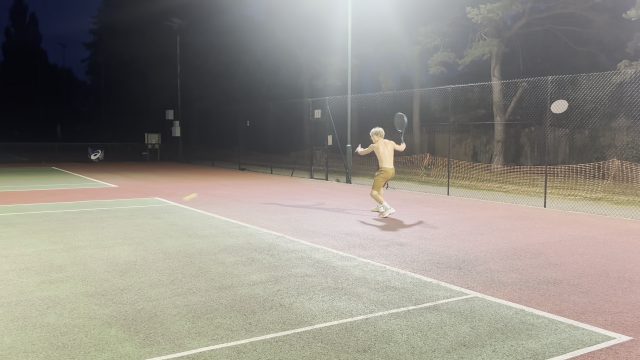
Too far awayToo small for the tracker to follow.
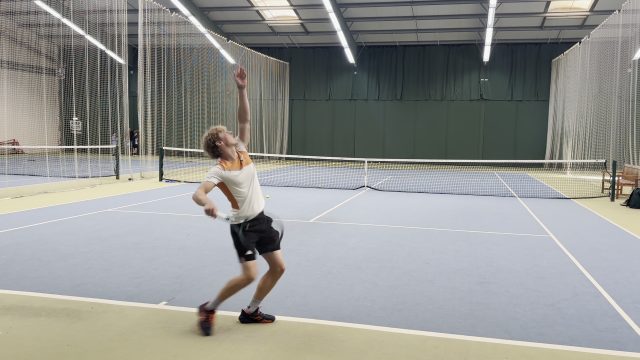
From behind, at an angleStance width and knee bend get
squashed, and the body hides the racket arm.
Why: filling 40–50% of the screen height, the player is tracked reliably. Below a
third, tracking starts to drop out. On a normal phone lens that's about 5–6 m away.
Filming a junior? Move closer, to about 4 m, so they still fill 40% of the height.
Camera angle
Do
Film side-on: at a right angle to the ball's path, level with where you hit.
Avoid
Filming from behind, from a steep diagonal, or from the stands looking down.
Why: side-on keeps stance and weight transfer in the plane one camera
measures well. From behind or at an angle they get squashed, and the numbers drift.
Film in landscape (phone sideways)
Do
Turn the phone sideways before you press record.
Avoid
Filming upright (portrait).
Why: a swing reaches out sideways. Portrait is too narrow for the racket at
full stretch, and leaves the player small.
Keep the camera still
Do
Tripod, fence clip, or the phone braced on something solid. Set the zoom once.
Avoid
Handheld, walking, or zooming and panning mid-swing.
Why: camera shake can hide a real shot entirely and shift scores even when
tracking is fine. A still camera is the most valuable thing you control.
Framing
Do
Whole body in frame for the whole swing, feet to head, with room for the racket. Stand
upright for a moment somewhere in the clip; between points is fine.
Avoid
Cutting off feet or head, or filming so close a limb leaves the frame mid-stroke.
Why: every distance (stance width, contact height, weight transfer) is scaled
from your height, measured while you stand upright and fully visible. No such frame, no
reliable scale.
Lighting
Do
Good daylight or a well-lit court, with the light behind or beside the camera.
Avoid
Filming into the sun or a bright window. It turns the player into a silhouette.
A few smaller things
One player per clip, with no one moving close behind them.
Fitted clothing tracks better than loose layers.
Enter your height accurately: every distance is scaled from it.
Record at 30 or 60 fps, your phone's normal setting, not a 24 fps “cinematic” mode.